
Core solution

ABM – Adaptive Behavior Monitor

ABM is a dedicated AI engine designed to detect selected abnormal behaviors on surveillance cameras and push alerts to operators in the control room – fast enough to support intervention, not just after-the-fact investigations.

Detection delay~5–15 secondsDepending on scenario complexity
Typical accuracy70–80%Under standard lighting conditions
Cameras per server30–35Per ABM AI server (reference load)
ABM – Adaptive Behavior Monitor

What operational problems does ABM address?

Continuous monitoring of many cameras is humanly impossible. ABM helps operations teams focus on signals that matter, at the right moment.

Reduced monitoring fatigue

Operators no longer need to constantly scan every screen. ABM surfaces prioritized alerts while keeping raw video streams available.

Early warning of risk

Detects patterns related to crowding, climbing, potential self-harm, aggression and tampering before they escalate.

Standardized scenarios

Scenarios and thresholds can be standardized at agency level, then adapted per facility or camera group.

Key capabilities

ABM is designed as a focused engine for behavior monitoring, not just generic object detection.

Behavior-based detection

Uses motion patterns, pose estimation and object context to detect behavior, not only static objects.

Zones & scenario rules

Define polygons, restricted corridors and high-risk areas, then attach scenario packs to each.

Per-camera profiles

Each camera gets its own profile including scene mask, scenario sensitivity and escalation logic.

Automatic escalation

Ranked alerts are pushed to the operator console with snapshots, clips and clear labels.

Continuous tuning

Operator feedback (confirm / dismiss) is logged and can be used to refine thresholds.

24/7 operation

Built to run continuously under fixed workloads in command centers and secure facilities.

Example behavior categories

Behavior packs can be turned on or off depending on policies and facility layout.

Perimeter & restricted zones

  • Unauthorized entry into restricted areas.
  • Approaching doors, windows or fences from unusual angles.

Climbing & escape attempts

  • Climbing or leaning over railings and fences.
  • Standing on elevated objects close to barriers.

Aggression & fights

  • Pushing, hitting and group aggression patterns.
  • Large groups forming quickly in sensitive areas.

Self-harm risk

  • Poses and motion patterns consistent with hanging attempts.
  • Long stays in high-risk positions (edges, rails, openings).

Weapons & dangerous objects

  • Carrying long or sharp objects resembling sticks, pipes or blades.
  • Passing dangerous items between individuals in restricted areas.

Infrastructure tampering

  • Cutting or sawing bars, locks or panels.
  • Drilling, digging or repeated attacks on walls and floors.

Policy violations

  • Smoking in non-smoking zones.
  • Gathering for gambling or prohibited group activities.

Fall & collapse differentiation

  • Distinguishes normal slips from suspicious collapses.
  • Flags falls that align with aggression or self-harm patterns.

ABM deployment model

ABM fits into a typical security infrastructure without disrupting existing workflows.
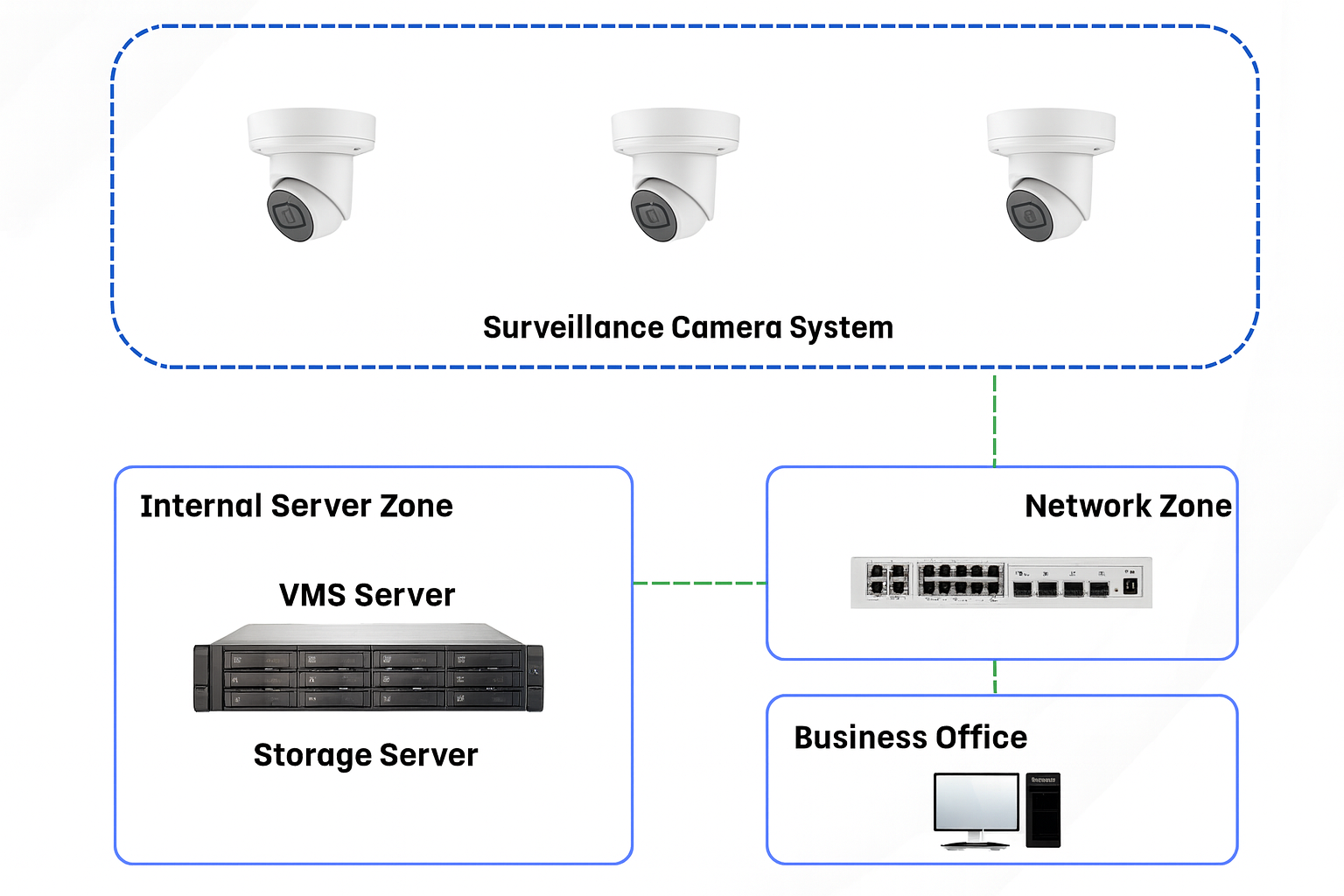
  • Camera layer: IP or analog-to-IP cameras streaming video feeds.
  • Network layer: L2/L3 switches segmenting traffic between cameras, servers and clients.
  • Server layer: VMS server for recording, ABM AI server for analysis and alert generation.
  • Operator layer: workstations and video walls, receiving alerts and reviewing evidence clips.
ABM deployment model
Camera layerIP / Analog + encoder
Switch / LAN
Server layerVMS · ABM AI server
Secure VLAN
Operator layerControl room · Workstations

Reference hardware profile

Final sizing depends on camera count, resolution and enabled scenarios. This is a typical starting point.

ABM AI server

  • Dell PowerEdge R760XD2 or equivalent.
  • Dual Intel Xeon (3rd generation), 256 GB RAM.
  • 6 TB SSD for models and cache.
  • Dual 10 Gb LAN, redundant power supplies.

VMS server

  • Dell PowerEdge XE8640 or equivalent.
  • Dual Xeon, 256 GB RAM.
  • 6 TB SSD plus HDD expansion for long-term video.
  • RAID and backup in line with policy.

Operator workstations

  • Dell Precision 3680 Tower or similar.
  • Xeon W CPU, 16 GB+ RAM, dedicated GPU.
  • 512 GB SSD + 1 TB HDD, 24″ IPS Full HD displays.

Network & rack

  • Extreme 5520-24T or similar 1G/10G switch.
  • 20U rack cabinet with power and cooling.
  • Cabling and accessories based on site survey.

Get in Touch

Contact us for more information about ABM system or to schedule a demo

Send Us a Message

Ready to evaluate ABM on a pilot site?

Send basic information – number of cameras, typical scenes and desired behavior packs – and we will propose a pilot plan.